

Submitted By: Debbie Waddell, LAc, Dipl.Ac
Whole Food Plant-Based Club
Nutrient density refers to the concentration of beneficial nutrients—vitamins, minerals, fiber, and lean protein—relative to the food’s total calorie count [1]. Nutrient-dense foods provide a high amount of these essential components with relatively fewer calories. Examples include most vegetables, fruits, beans, and legumes [1].
In contrast, calorie density (or energy density) measures the number of calories per given weight of food [1]. Foods high in calorie density provides “many” calories but may offer “limited” nutrients [1]. Examples include all processed foods, fried items, and sugary snacks. Generally, high water and fiber content decrease a food’s calorie density, while high fat content increases it [1].
The main difference between the two concepts is that you can consume a larger volume of a low-calorie-density food for the same number of calories as a smaller volume of a high-calorie-density food.
See the sample below, the plate of pasta is half the calories of a full plate of pasta. So if you’re a volume eater, like me, I want a huge bowl of pasta, but I don’t want all the calories. I peel and spiralize the zucchini and let it sit out to get room temperature.
Next, I add a jar of Simply Organic Marinara sauce, add some vegetables and you have a quick dinner.
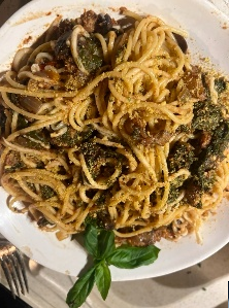
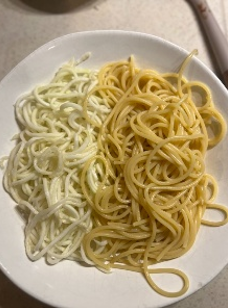
Here is an example comparing a whole plate of traditional pasta with a half-pasta, half-zucchini noodle plate:
| Feature | Whole Plate of Traditional Pasta | Half-Pasta, Half-Zucchini Noodles |
| Calorie Density | Higher. Pasta, while providing some nutrients, is relatively high in calories per serving size. | Lower. Zucchini has very few calories compared to the same volume of pasta, thereby reducing the overall calorie density of the plate [2]. |
| Nutrient Density | Moderate. Whole-wheat pasta offers some fiber and complex carbohydrates. | Higher. Zucchini is rich in vitamins (such as C and K), potassium, and fiber, adding significant nutritional value with few calories [2]. |
| Satiety/Volume | Provides calories, but the volume might be less filling than the mixed plate for the same calorie count. | Provides a greater volume and more fiber due to the zucchini, which is likely to result in a greater feeling of fullness and satisfaction, helping to manage hunger effectively [1, 2]. |
By swapping out half the traditional pasta for zucchini noodles (zoodles), you effectively maintain a satisfying portion size and mouthfeel while significantly reducing the total calorie count and boosting the nutritional content of the meal [2]. This strategy enables hunger management while consuming a more nutrient-rich and lower-calorie meal [1, 2].
Why Join The VHA?
-
Communication
Bring YOUR voice to our community
-
Education
News and courses to enlighten and inform
-
Volunteering
Because we can't do our job without you!
-
Social Opportunities
Spend time with fellow residents and create friendships along the way
-
Philanthropy
Providing for those in need through our VHA Foundation and Helping Hands

Next Article: