

Take care of your kidneys
Your kidneys act as your body’s main filtering system. Over time, they may become damaged and unable to work as well as they should; this leads to kidney disease. There are many steps you can take to help keep your kidneys healthy.
Your body’s waste disposal team
The kidneys are two bean-shaped organs located in the middle of the back, just under the ribs. The main role of the kidneys is to filter blood to prevent waste and extra fluid from building up in the body. The kidneys also know the volume of minerals the body needs to be well balanced, and they get rid of extra minerals through urine.1
When the kidneys don’t work like they should
Kidney disease means the kidneys are damaged and unable to filter blood like they should, causing waste to build up in the body. When the kidneys become severely damaged, a person can develop kidney failure, which means the kidneys do not work well enough on their own to maintain life.2
Anyone can develop kidney disease, but people who have diabetes, high blood pressure, heart disease, and a family history of kidney disease are at a higher risk.3
Know your kidney numbers
Early kidney disease often has no signs or symptoms. This means that the only way to know how well your kidneys are functioning may be to get screened.
There are two main screenings:
- GFR blood test. A glomerular filtration rate (GFR) blood test tells how well the kidneys are filtering.4
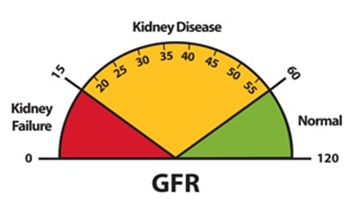
- Urine albumin test. A urine albumin test detects a protein in the blood that shouldn’t be passed in the urine. A urine albumin level below 30 is normal, while a urine albumin level above 30 is abnormal and may indicate kidney disease.4
Keeping your kidneys healthy
Image source: National Heart, Lung and Blood Institute
There are many steps you can take to help protect your kidneys.
- Stay in control of other health conditions. Managing diabetes and high blood pressure helps prevent damage and manage kidney disease. Learn what numbers are considered acceptable for your condition and work with your healthcare team to come up with a plan that’s right for you.
- Keep a healthy body weight. Being overweight makes your kidneys work harder and increases your risk of high blood pressure and diabetes.6 A realistic, achievable weight-loss plan that addresses changing your diet and activity level may help you achieve long-term success.6
- Closely monitor your kidney health. Your healthcare team will track your kidney function and damage over time. Keep up with your test results and how they compare with previous results. In general, your goals will be to keep your GFR the same and/or keep your urine albumin the same or lower.5
- Eat the right foods. What you eat and drink can affect your kidney health. Eating the right amount of protein, sodium, phosphorus, calcium and potassium may help control the buildup of waste and fluid in your body, so that your kidneys don’t have to work as hard.7 Talk to your healthcare team to find out if you need to limit certain nutrients and/or fluids.
- Avoid smoking and alcohol. Smoking and drinking too much alcohol can decrease kidney function and make kidney disease worse.8,9
- Talk to your healthcare provider about medicines. If you have decreased kidney function, work with your healthcare team to determine which medicines you need—and which to avoid.
Interested in learning more? Visit www.HumanaNeighborhoodCenter.com to register for live and on-demand health education classes.
This is for informational purposes only and does not replace treatment or advice from a healthcare professional. If you have questions, please talk with your doctor. Talk to your doctor before beginning an exercise program or making any changes to your diet.
Sources
- “Your Kidneys & How They Work,” National Institute of Diabetes and Digestive and Kidney Diseases, last accessed April 8, 2025, https://www.niddk.nih.gov/health-information/kidney-disease/kidneys-how-they-work.
- “Chronic Kidney Disease (CKD),” National Institute of Diabetes and Digestive and Kidney Diseases, last accessed April 8, 2025, https://www.niddk.nih.gov/health-information/kidney-disease/chronic-kidney-disease-ckd.
- “Causes of Chronic Kidney Disease,” National Institute of Diabetes and Digestive and Kidney Diseases, last accessed April 8, 2025, www.niddk.nih.gov/health-information/kidney-disease/chronic-kidney-disease-ckd/causes.
- “Chronic Kidney Disease Tests & Diagnosis,” National Institute of Diabetes and Digestive and Kidney Diseases, last accessed April 8, 2025, www.niddk.nih.gov/health-information/kidney-disease/chronic-kidney-disease-ckd/tests-diagnosis.
- “Estimated Glomerular Filtration Rate (eGFR),” National Kidney Foundation, last accessed April 8, 2025, https://www.kidney.org/kidney-topics/estimated-glomerular-filtration-rate-egfr.
- “Managing Chronic Kidney Disease,” National Institute of Diabetes and Digestive and Kidney Diseases, last accessed April 8, 2025, www.niddk.nih.gov/health-information/kidney-disease/chronic-kidney-disease-ckd/managing.
- “Overweight and Obesity,” National Kidney Foundation, last accessed April 8, 2025, https://www.kidney.org/kidney-topics/overweight-obesity.
- “Smoking and Your Health,” National Kidney Foundation, last accessed April 8, 2025, https://www.kidney.org/kidney-topics/smoking-and-your-health.
- “Alcohol and Your Kidneys,” National Kidney Foundation, last accessed April 8, 2025, https://www.kidney.org/kidney-topics/alcohol-and-your-kidneys.

Why Join The VHA?
-
Communication
Bring YOUR voice to our community
-
Education
News and courses to enlighten and inform
-
Volunteering
Because we can't do our job without you!
-
Social Opportunities
Spend time with fellow residents and create friendships along the way
-
Philanthropy
Providing for those in need through our VHA Foundation and Helping Hands